How to Follow Up a Quote and Stop Losing Jobs You've Already Priced
When to follow up a quote, what to text, and how many times to try. The 2-7-14 rule, five copy-paste templates, and what unanswered quotes cost you.

Paul Coleman · Co-founder, Korda Pro
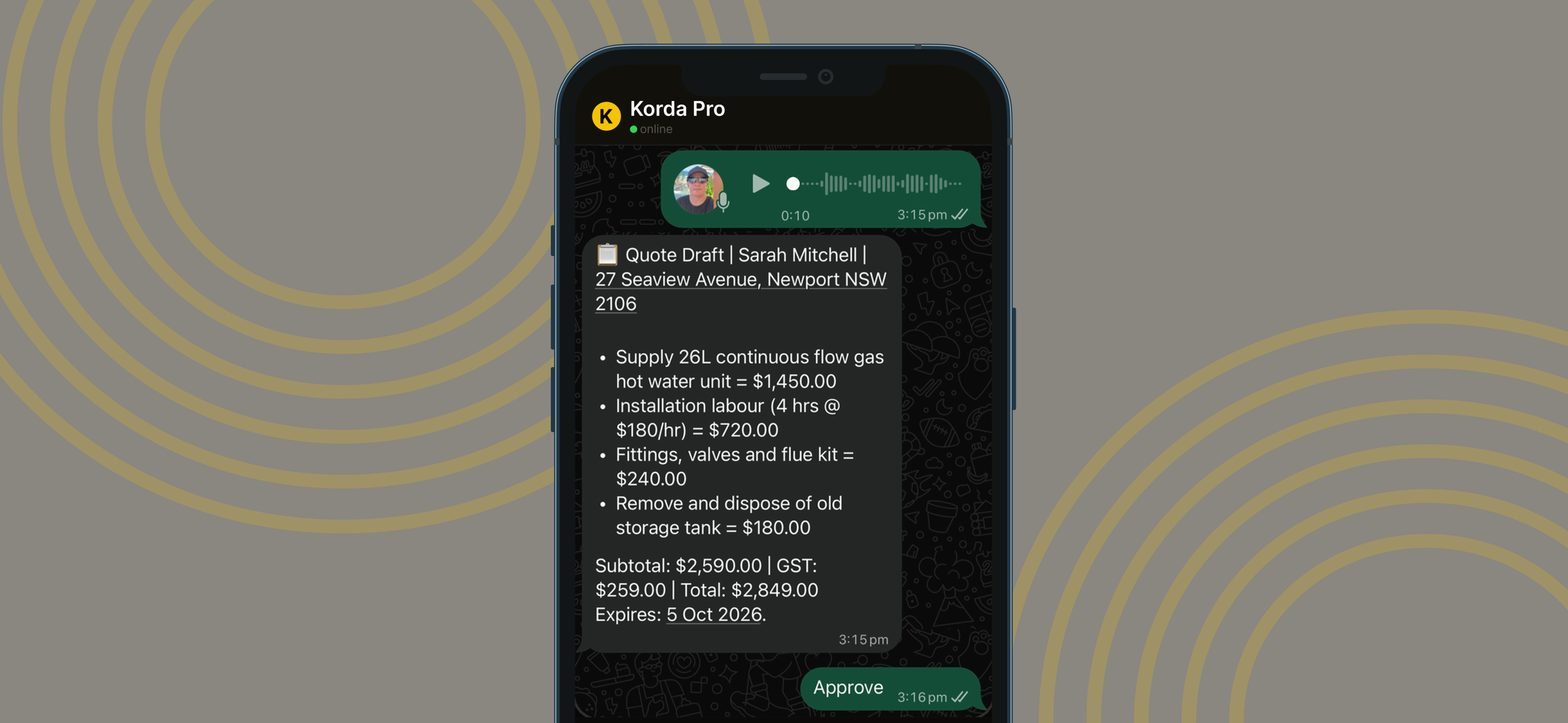
Most tradies are good at pricing a job. Far fewer follow up on a quote consistently once it's sent. They turn up, measure, price the job properly and send the quote. Then they wait. If the customer comes back, great. If they don't, the quote quietly dies, and nobody ever finds out why.
That silence is expensive. By the time a quote is in the customer's hands, you've already done the hard part of winning the job. They found you. You've been on site, or talked the job through and checked the photos you asked for, and you've put a number in front of them. A short follow-up is the cheapest bit of selling you'll ever do, and it's the bit most often skipped or done half-heartedly.
This guide covers when to follow up a quote, what to text or email, how many times to try, what every unanswered quote is really costing you, and how to make sure follow-ups happen even when you're flat out.
When should you follow up a quote? The short answer
Follow up a quote two days after sending it with a short message asking if the customer has any questions. If you hear nothing, follow up again at seven days with something useful, such as your availability, and send a final message at fourteen days to close the quote off. We call this the 2-7-14 rule. Keep each message short, specific to the job and easy to reply to. Three follow-ups are enough. After that, let it go.
Why customers don't reply to quotes
Silence rarely means no. Knowing what's behind it helps you write follow-ups that actually get a reply. The usual reasons customers don't reply to a quote are:
- They're comparing quotes and waiting for the others to come in.
- They have a question about timing, what's included or how payment works, and haven't got around to asking it.
- The price was higher than they expected and they're not sure how to say so.
- Someone else needs to sign off: a partner, a landlord or a strata committee.
- Life got in the way, and your quote is sitting in an inbox under forty other emails.
Only one of those is close to a genuine no, and even then a conversation about scope can often save the job. Every other reason is something a well-timed message can solve.
Why tradies don't follow up on quotes
It isn't laziness. The same three things come up again and again.
Time
Quotes tend to get written at the end of the day. The follow-up needs to happen days later, when you're on the tools, and the quote is the last thing on your mind.
Awkwardness
Chasing someone for work can feel like begging, or like being the pushy salesman nobody wants to deal with.
No system
Follow-ups rely on memory, a paper diary or scrolling back through your texts. That works when you're quiet and falls apart when you're busy, which is exactly when the most quotes are going out.
The first two are solved by having the words ready and a schedule to follow. The third needs a system, whether that's calendar reminders or software that does it for you.
On the worry about being pushy: most customers read a follow-up as a sign you're organised and want the work. A tradie who follows up on a quote looks like a tradie who'll turn up on the day. The one who goes quiet looks like the one who might not.
The 2-7-14 quote follow-up schedule
This quote follow-up schedule suits most residential jobs. Adjust the spacing to the size of the job (see below).
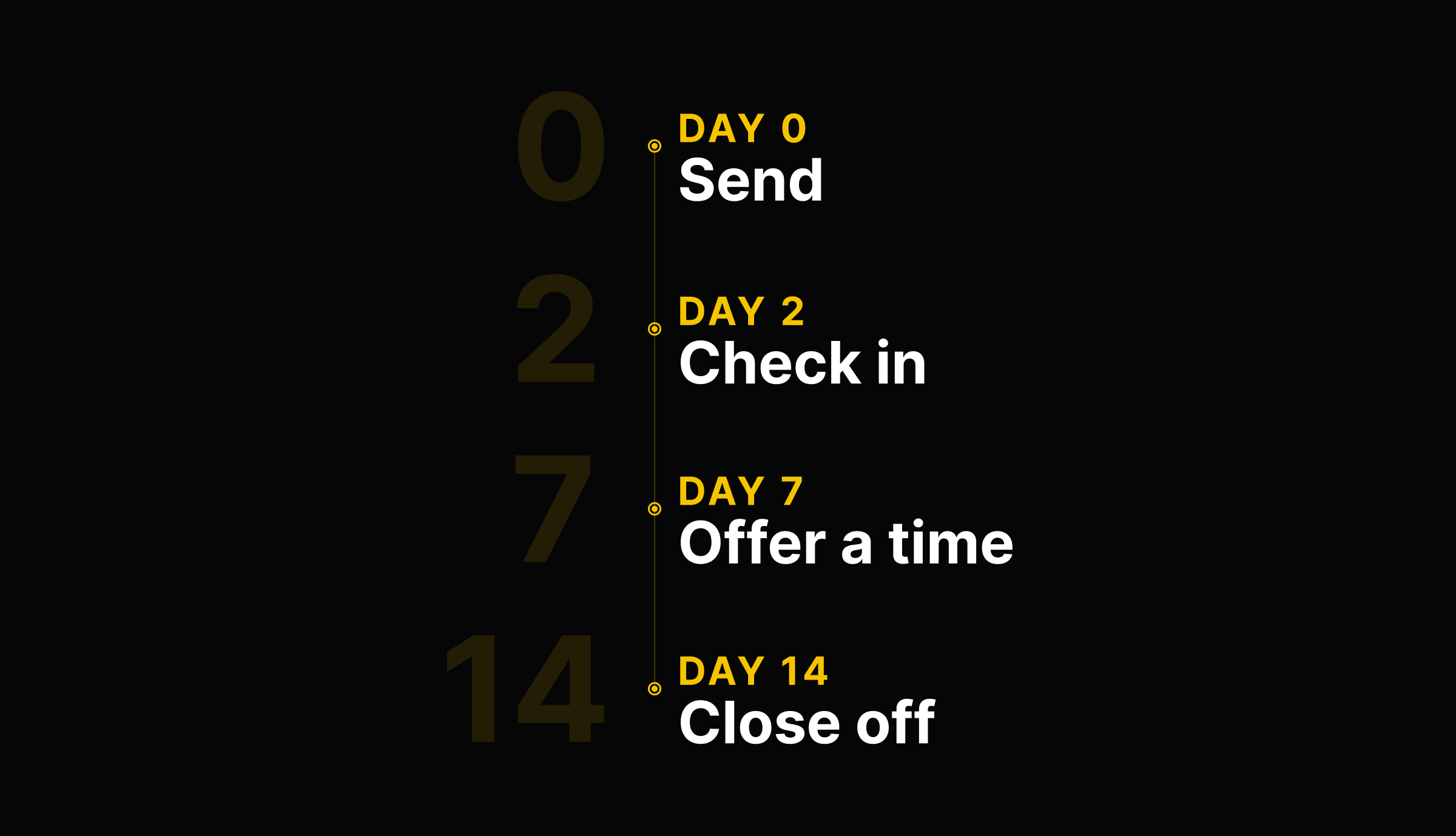
| When | What to send | What it does |
|---|---|---|
| Day 0 | Send the quote and say when you'll check in | Makes the follow-up expected |
| Day 2 | Ask if they have any questions | Catches unasked questions |
| Day 7 | Offer a time or a scope option | Gives them a reason to reply |
| Day 14 | Close the quote off politely | Asks for a decision |
Tell them when you'll check in. The most useful line in any quote email is the one that says when you'll be in touch. "I'll check in on Thursday in case you've got questions" turns your follow-up from an interruption into something they're expecting.
Put a validity period on every quote. Thirty days is common for residential work. It gives you a genuine reason to get back in touch, and it protects you when material prices move.
Match the pace to the job. A leaking tap or a dead power point moves fast. Follow up the same day or the next, because the customer will book whoever gets back to them first. A bathroom renovation or a switchboard upgrade moves slowly. Customers take weeks to decide, so stretch the spacing out and make one of your follow-ups a phone call.
What to text a customer after sending a quote: 5 templates
A few rules apply to every follow-up message:
- Use their name and mention the job, so it doesn't read like a mass text.
- Ask one clear question they can answer in a few words.
- Keep it short. If it doesn't fit on a phone screen without scrolling, cut it.
- Leave out the guilt. "Just following up again as I haven't heard back" can make people feel told off, and they avoid replying to messages that make them feel bad.
For small residential jobs, a text usually gets a faster response than an email because people read texts more quickly. Email still works as a backup, particularly if you attach the quote again so they don't have to go looking for it. The same wording works for a quote follow-up email. Use a plain subject line such as "Your quote for the bathroom fan" so it's easy to find in their inbox.
Swap in your own details and wording. The point is the structure, not the exact words.
1. When you send the quote
Hi Sarah, your quote for the bathroom fan and light is attached. Happy to walk you through any of it. I'll check in on Thursday in case you've got any questions. Cheers, Dave
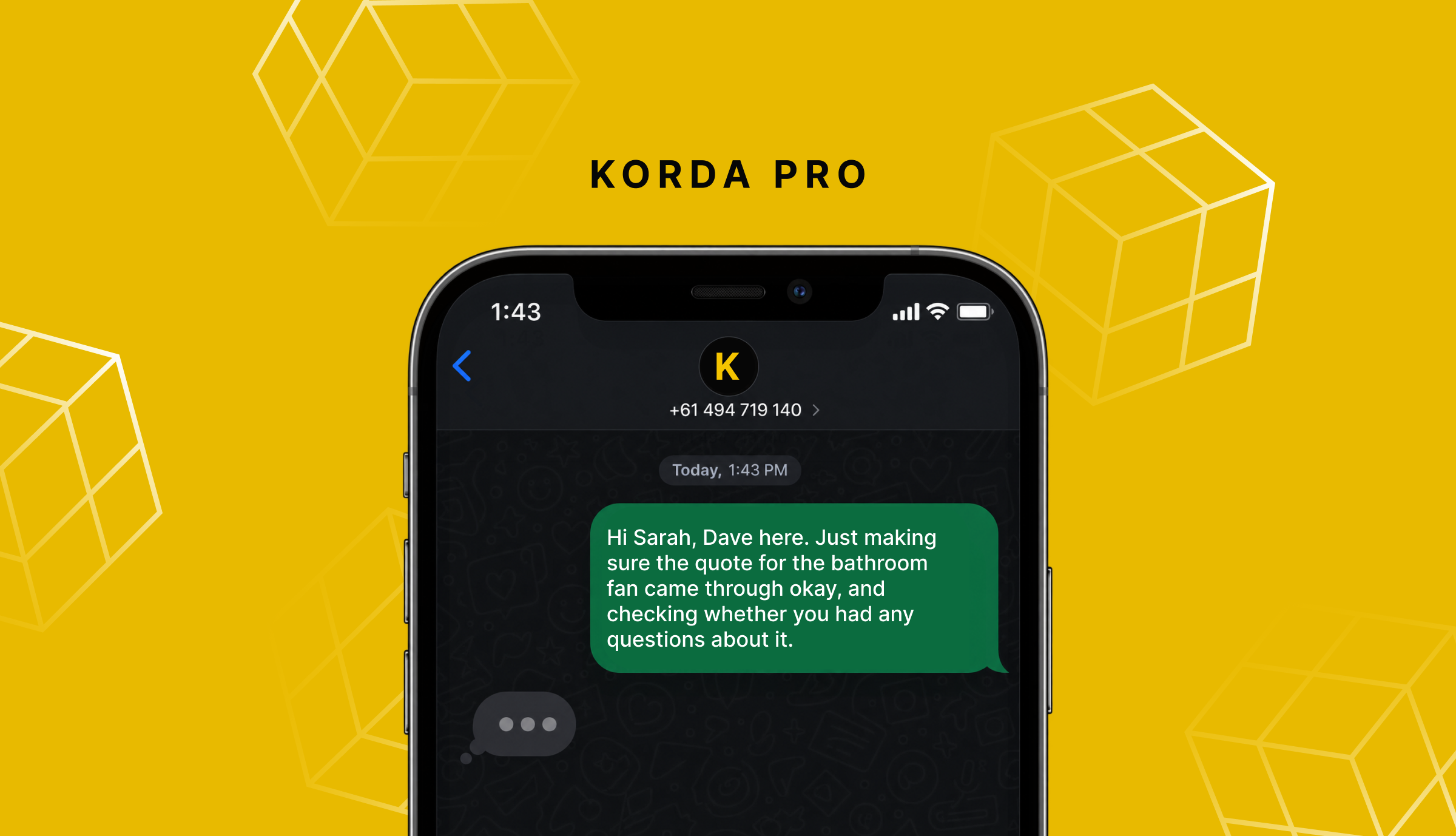
2. The first check-in (day 2)
Hi Sarah, Dave here. Just making sure the quote for the bathroom fan came through okay, and checking whether you had any questions about it.
3. The second check-in (day 7)
Give them something useful rather than just asking again. Two options that work well:
Availability
Hi Sarah, I've had a spot open up next Tuesday and Wednesday if you'd like to go ahead with the bathroom fan. Let me know, and I'll lock it in.
Scope
Hi Sarah, if the bathroom quote came in higher than you were expecting, I'm happy to look at options. We could do the fan now and the light later, for example. Just let me know.
The scope message is worth its weight in gold. It gives a customer who thinks the price is too high a way to say so without an awkward conversation, and it keeps the job alive without you having to cut your rate.
4. Closing the quote off (day 14)
Hi Sarah, I'll close off the quote for the bathroom fan at the end of the week so I can plan my schedule. If you'd still like to go ahead, or want to pick it up again later, just let me know. No worries either way.
This one often gets a reply when the others didn't, because it asks for a decision rather than an update.
5. When they say no
Thanks for letting me know, Sarah. I appreciate it. Mind if I ask what swayed it? Always keen to improve. If anything else comes up, give me a call.
Most tradies never ask this, and it's some of the most useful information you'll get. If the answer is "price" three times in a row, that tells you something. If it's "the other bloke got back to me quicker", that tells you something different.
What does an unanswered quote cost? Work out your cost per won job
Most tradies think of an unanswered quote as nothing lost. It's the opposite. Every quote costs you time: the phone call, the drive to site, measuring up, pricing materials and writing it up. That time has a dollar value, and you pay it whether you win the job or not.
The clearest way to see it is to work out your cost per won job. It's a simple number that almost no tradie tracks:
Here's an example. The numbers are illustrative, so plug in your own.
- You send 20 quotes a month, each taking about 1.5 hours. That's 30 hours of quoting.
- At $100 an hour, that's $3,000 of your time every month.
- You win 8 jobs. The $3,000 is spread across those 8, so each job you win carries $375 of quoting time.
- Following up wins you 2 more from the same 20 quotes. Now the $3,000 is spread across 10 jobs, so each carries $300. At an average job value of $1,500, you've also added $3,000 of work a month.
Put simply, every job you win has to pay for the quotes you didn't win. Following up means the same quoting effort produces more jobs, so each one costs you less to win.
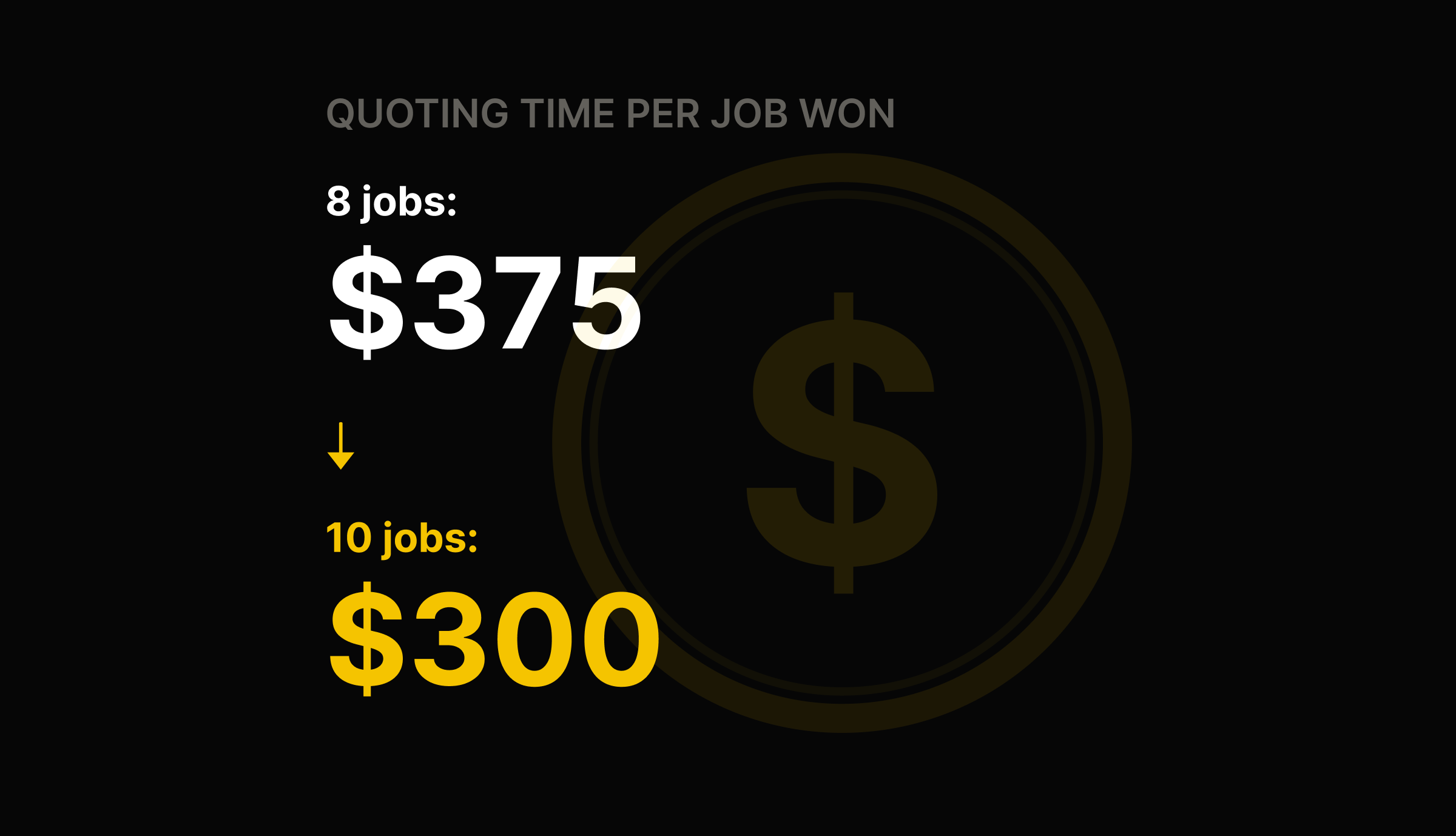
So following up works on both sides of the ledger. It brings in more work, and it makes every quote you've already written cheaper. Over a year, those two extra jobs a month add up to $36,000 of work from quotes you'd already done the work for.
It also changes how you should think about a quote that goes quiet. In the example above, each quote carries $150 of your time. Leave it unanswered, and you've spent that money and walked away. A two-minute follow-up is how you get it back.
The same maths explains why following up beats chasing new leads. A new enquiry through ads or a lead site costs money before you've even quoted, and then it costs the same quoting time on top.
The same leak shows up after the job, too, when invoices go out late. We've worked through those numbers in what late invoicing really costs Australian tradies.
How to automate quote follow-ups
A schedule only helps if you stick to it, and the weeks you're busiest are the ones it slips in. There are three ways to make sure your quote follow-ups actually happen.
Reminders in your phone. When you send a quote, set reminders for day 2, 7 and 14. It's free, and it works if you're disciplined. The weak spot is that it still relies on you acting on the reminder at the end of a long day.
Your job management software. Most job management platforms include some form of automated quote reminder. If you already run one, check it's switched on and that the wording sounds like you, not like a bank.
Korda Pro. Korda Pro is the money layer for small trade businesses: quoting, invoicing and chasing payment with SMS and email follow-ups, straight into Xero. You describe the job in a voice note or a message, check the draft in WhatsApp and approve it before anything goes to the customer. Once a quote is sent, Korda Pro follows it up for you, so the check-ins happen whether you remember or not. When the customer says yes or no, you tell Korda Pro via WhatsApp, and your records and Xero are updated. It isn't job management software and doesn't try to replace your scheduling tool. It looks after the part of the business that turns work into money.
Quote follow-up mistakes to avoid
- Sending the quote days after the site visit. The best follow-up in the world won't rescue a quote that arrived after the customer had already booked someone else. Aim for the same day or the next.
- Following up with "any update?" It gives the customer nothing to respond to. Ask a specific question or offer something useful.
- Discounting before anyone asks. Offering a lower price in a follow-up tells the customer your first number wasn't real. Offer options on scope instead.
- Following up forever. After three attempts, close it off politely and move on. Your time is better spent on the next quote.
- Not asking why you lost. A lost job you learn from is worth more than one you never think about again.
- Leaving the validity date off. Without one, a customer can turn up six months later expecting last season's material prices.
Quote follow-up FAQs
How long should I wait before following up a quote?
Around two days for most residential jobs. For small, urgent jobs, follow up the same day or the next. For large jobs such as renovations, allow three to five days, as customers need more time to decide.
How many times should I follow up a quote?
Three times is enough: a check-in at around two days, a second at about a week, and a final message at around two weeks that closes the quote off. More than that starts to feel like pressure.
What is the 2-7-14 rule for quote follow-ups?
The 2-7-14 rule is a simple quote follow-up schedule. Check in two days after sending the quote, follow up at seven days with something useful such as your availability, and close the quote off at fourteen days. It keeps you front of mind without being pushy.
Should I follow up a quote by text, email or phone?
A text is usually best for small residential jobs because it's quick to read and easy to reply to. Email works well as a backup, especially with the quote attached again. For bigger jobs, make at least one of your follow-ups a phone call.
What should I say when following up a quote?
Use the customer's name, mention the job, and ask one simple question, such as whether they have any questions about the quote. On the second follow-up, offer something useful, like your availability or an option to change the scope.
Is it pushy to follow up on a quote?
Not if it's short and polite. Most customers see a follow-up as a sign you're organised and keen to do the work. What comes across as pushy is chasing too often, using guilt, or pressuring on price.
How long should a quote be valid for?
Thirty days is common for residential work. If material prices are moving quickly in your trade, a shorter period protects you. Whatever you choose, put it on every quote.
How do I work out what my quotes are costing me?
Multiply the number of quotes you send by the hours each one takes and your hourly rate, then divide by the number of jobs you win. That's your cost per won job. Following up lowers it, because the same quoting time produces more work.
What is a good quote conversion rate for tradies?
It varies widely by trade, job size and where the lead came from, so industry averages aren't much use. The number that matters is your own. Track how many quotes you send and how many you win for a couple of months, then see what changes once you follow up consistently.
The bottom line
Following up a quote isn't about hard selling. It's about not walking away from work you've already earned the right to win. Send the quote quickly, tell the customer when you'll check in, and then actually check in. Twice more if you need to, then close it off.
Do that consistently and you'll win more of the jobs you're already pricing, without spending another dollar on finding new ones.