The $30,000 Gap: What Late Invoicing Really Costs Australian Tradies
Australian tradies lose thousands a year to late invoicing and slow follow-up. See the real data on unpaid invoices and tradie cash flow, and what a tighter billing cycle is worth.
Korda Team
The number most tradies don't know
There is a figure that most Australian trade business owners have never calculated. It is the gap between the cash they earned last year and the cash they actually collected on time. It is not sitting in bad clients or bad luck. It is sitting in invoices that went out a few days late, reminders that never got sent, and overdue accounts that quietly aged past the point anyone wanted to chase them.
The data on this is now well documented, and it is worse in construction and trade services than in almost any other Australian industry.
How much are Australian tradies actually losing?
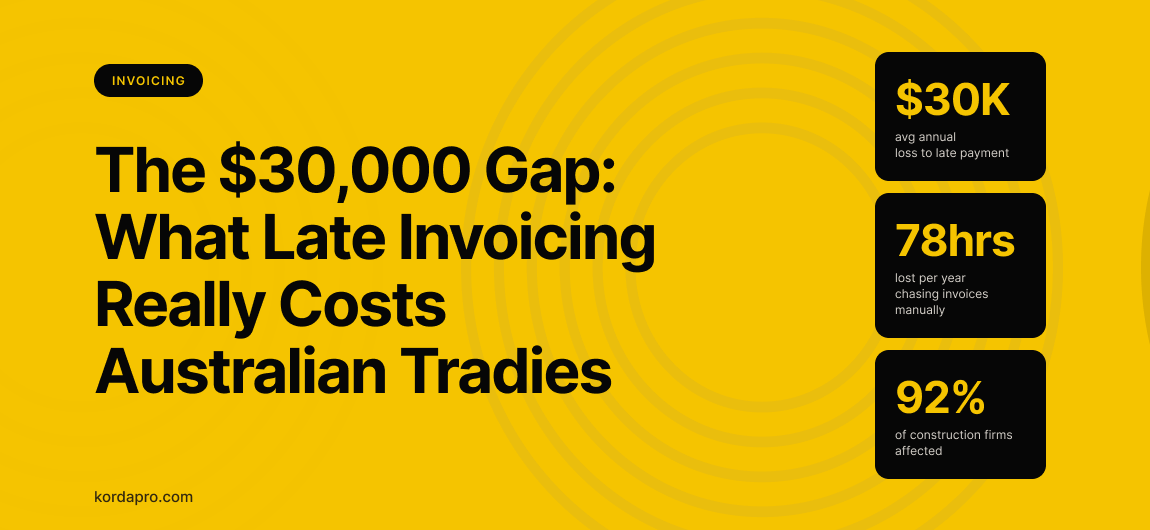
Start with the scale of the problem nationally. Australian small and medium businesses are collectively owed more than $115 billion in unpaid invoices at any given time. Construction sits at the sharp end of that number: 92 per cent of construction firms report having had overdue invoices in the past 12 months, and 39 per cent say invoices were overdue by more than 30 days, the highest rate of any industry CreditorWatch tracks.
92%
of Australian construction firms report having had overdue invoices in the past 12 months, the highest rate of any industry tracked.
At the individual business level, GoCardless's 2025 Pursuing Payments report, based on a YouGov survey of 500 Australian small and medium business owners, found that 17 per cent of Australian SMBs lose more than $2,500 a month to late payments, up from 11 per cent the year before. At that rate, the annual cost is around $30,000. Separate research from Airwallex puts the average Australian small business loss at $2,408 a month, or roughly $29,000 a year, with 84 per cent of Australian SMEs losing up to $4,999 a month to overdue invoices.
Two independent data sets, two different methodologies, landing in the same place: for a meaningful share of Australian trade and small businesses, late payment is a five-figure annual cost. Not because clients refuse to pay. Because the systems for invoicing, follow-up, and chasing overdue accounts have gaps that allow cash to sit unclaimed.
Why the money disappears: three points where cash leaks
The research points to the same three failure points, again and again, across every industry study on this topic.
1. The invoicing delay
For most sole operators and small crews, an invoice does not go out the moment a job finishes. It goes out that evening, the next morning, or in a Friday batch, because the job finishes with WhatsApp open and the invoicing app closed. That delay matters more than it looks. Xero's own payment-terms research found that invoices issued with one-week payment terms are, on average, actually paid in about two weeks, not one. The later an invoice goes out, the further behind it starts, and the harder it is to claw back that time.
2. The follow-up gap
A seven-day reminder is the cheapest, highest-return action in the entire collection process. It catches the client who simply forgot before they become a client who is avoiding the call. Most trade businesses without an automated system do not send one on schedule. GoCardless found that 63 per cent of Australian SMBs spend meaningful time chasing overdue invoices themselves, averaging 1.5 hours a week, more than 78 hours a year, or close to two working weeks spent manually doing what a system should do automatically.
The same leak starts earlier, with quotes that never get a follow-up. Our quote follow-up templates cover what to send and when.
3. The 60-day cliff
Once an invoice drifts past 30 days, recovery gets harder, and the conversation gets more awkward to restart. Construction is the worst-affected sector on this measure nationally: CreditorWatch's most recent Business Risk Index put construction invoices more than 60 days overdue at 7.15 per cent, among the highest of any industry, as national late payments hit a six-year high. Every week an invoice sits without a structured follow-up, the odds of it becoming a write-off go up.
A worked example: one trade business, one year
To make this concrete, here is an illustrative model, not a national average, built from the data above and applied to a typical small trade business.
Business profile: 30 jobs a month, average invoice value $1,100, annual revenue around $400,000, in line with the CreditorWatch and GoCardless survey base of Australian trade and construction SMEs.
Invoicing delay: a 3- to 5-day average gap between job completion and the invoice being sent, consistent with the industry pattern Xero describes, pushes the effective collection cycle out by roughly a week over the year.
Follow-up gap: without an automated 7-day reminder, a meaningful share of invoices join the 39 per cent of construction-sector invoices CreditorWatch found sitting overdue by more than 30 days at any time.
60-day cliff: a portion of those aged invoices lands in the 7.15 per cent of construction invoices nationally that go more than 60 days overdue, where recovery odds drop and some balances are eventually discounted or written off.
Applying the GoCardless and Airwallex per-business figures ($29,000 to $30,000 a year for businesses affected at this level) to a business of this size is consistent with losing roughly one week of cash-flow timing on billing, plus a smaller tail of invoices that age into write-offs or negotiated discounts. That is the shape of the $30,000 gap: mostly a cash-flow timing problem, with a real minority becoming a permanent loss.
What tightening the cycle actually changes
The fix does not require chasing harder. It requires removing the two points where the process depends on someone remembering to act: sending the invoice the same day the job finishes, and sending a follow-up on a fixed schedule without anyone having to think about it.
Businesses that close the invoicing delay and automate the 7-day reminder consistently report fewer invoices ageing past 30 days, which is the single biggest lever in the CreditorWatch and GoCardless data, since almost every downstream loss traces back to an invoice that was still open at that mark. None of that is new revenue. It is money already earned, moving through the business on time instead of drifting.
Frequently asked questions
How much do Australian tradies lose to late invoicing each year?
Independent research from GoCardless and Airwallex puts the figure at roughly $29,000 to $30,000 a year for the share of Australian small businesses most affected, with construction reporting the highest rate of overdue invoices of any industry tracked by CreditorWatch.
Why do trade businesses get paid late so often?
The two biggest drivers are a delay between job completion and the invoice being sent, and the absence of a systematic follow-up once an invoice passes its due date. Both are process gaps rather than client behaviour problems.
What is the fastest way to reduce unpaid invoices?
Send the invoice on the day the job is completed and automate a follow-up at the 7-day mark. Xero's research shows that invoicing speed directly affects how quickly a client pays, and GoCardless's data shows that most of the time businesses lose chasing invoices is spent on manual follow-up that a system can handle automatically.
At what point does an overdue invoice become a write-off risk?
CreditorWatch's data show the risk accelerates once an invoice is more than 30 days overdue, and construction has the highest share of invoices crossing the 60-day mark of any industry it tracks.
Sources
CreditorWatch, construction overdue invoices and payment defaults — https://build-it.au/tradies/industry-news/construction-cash-crunch-as-late-payments-hammer-tradies
CreditorWatch, Business Risk Index, late payments six-year high — https://creditorwatch.com.au/blog/late-payments-hit-six-year-high-in-australia
GoCardless, 2025 Pursuing Payments Report (Australia) — https://www.accountantsdaily.com.au/business/21719-late-payments-a-productivity-drain-for-aussie-companies-survey-finds
Airwallex, cost of late payments to Australian SMEs — https://www.getunpaid.io/blog/hidden-cost-late-payments-australia
Xero, invoice payment terms research — https://www.xero.com/us/guides/invoicing/invoicing-process/
Business Builders, $115 billion owed to Australian small businesses — https://businessbuilders.com.au/news/opinion/why-late-payments-are-strangling-small-business-and-what-needs-to-change/