Why Tradies Are Switching to WhatsApp Invoicing
Late invoicing isn't a discipline problem; it's a friction problem. See why Australian tradies are moving invoicing into WhatsApp, and what it does to payment speed.
Korda Team
It's 3:40pm. The job's done. You're loading the last of the gear into the ute, and the client has just walked back inside after shaking your hand. WhatsApp is already open on your phone; it's been open all day. The thread with the client is right there. The photos you sent an hour ago are still on screen.
You know you should invoice now. You know it.
This is the week most Australian trade business owners are actually running, not the version where the admin is under control, but the version where it follows you home, sits at the table with you, and takes the hours that were supposed to be off.
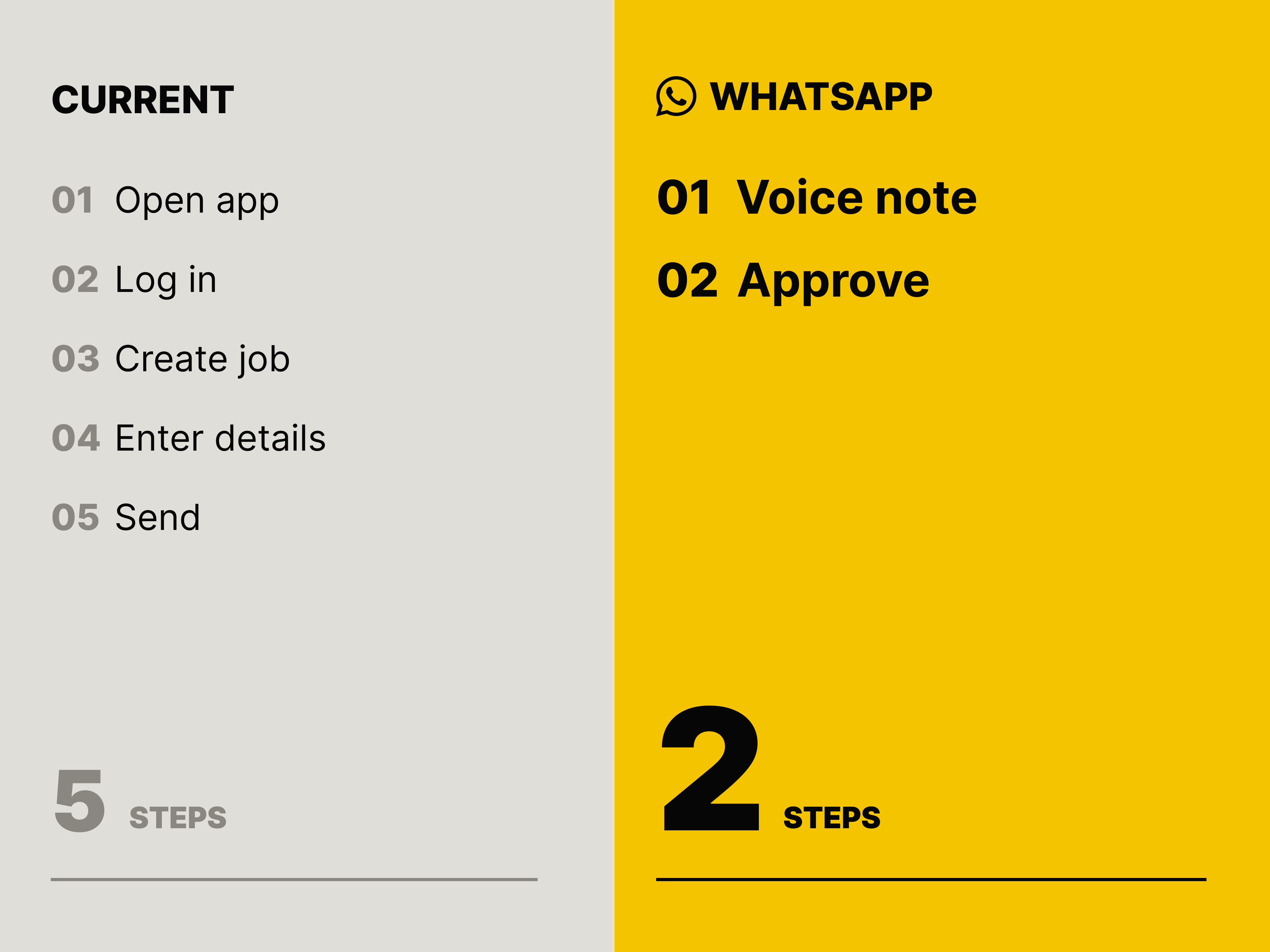
But the invoice is in a different app. That app needs a login. You'll need to create the job, enter the client details, type out the line items from memory, check the GST, and set the due date. It's not that it's hard. It's that it's not here, right now, in the app you're already holding.
I'll do it tonight, you think. And you will. Probably.
This is the pattern behind WhatsApp invoicing for tradies: a shift in how Australian trade businesses choose to send invoices, and it's not really about the app. It's about where the invoice comes from.
Late invoicing is a friction problem, not a discipline problem
Every tradie who invoices late has tried to fix it. Phone reminders. Batch invoicing on Friday afternoons. Moving the app to the home screen. Promises to do it before leaving the driveway.
None of it sticks, and here's why: all of those fixes treat the symptom. The symptom is the delayed invoice. The cause is a system that requires you to leave the moment, to close WhatsApp, open a different app, and start a separate workflow, at exactly the point when your hands are full, and your head is already on the next job.
The rational response to a system with unnecessary friction is to defer the task until the friction is lower. That's the couch at 10pm. It's not laziness. It's your brain correctly identifying that the path of least resistance runs through the evening, not the driveway.
Late invoicing isn't a discipline problem. It's a friction problem. Remove the friction at the moment that matters, and the behaviour changes on its own.
What a three-day invoicing delay actually costs
Run the numbers on a typical trade business. Twenty jobs a month, average invoice value of $900. If each invoice goes out three days after the job is complete, which is optimistic for most sole operators, then every invoice starts its payment clock three days late.
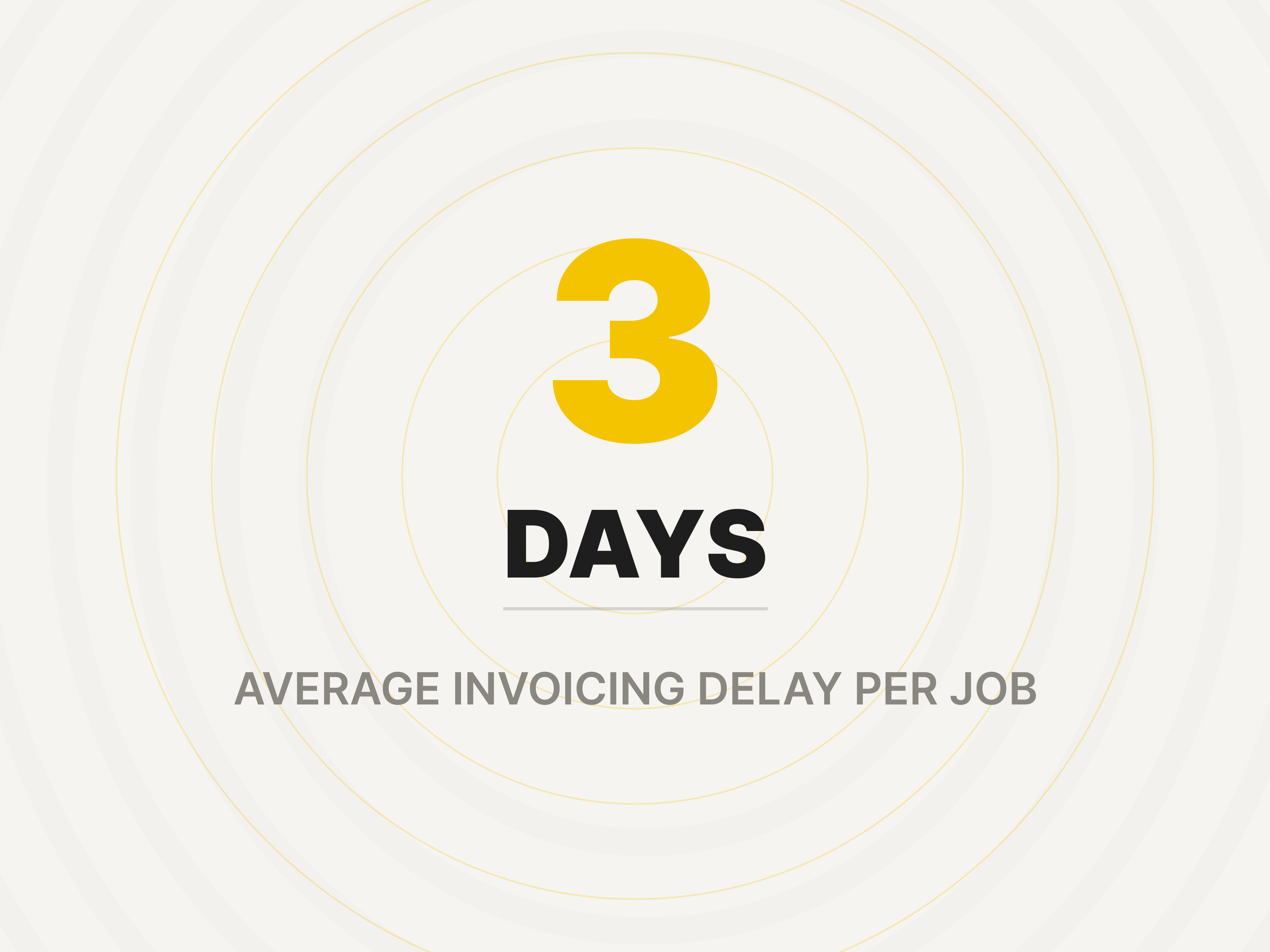
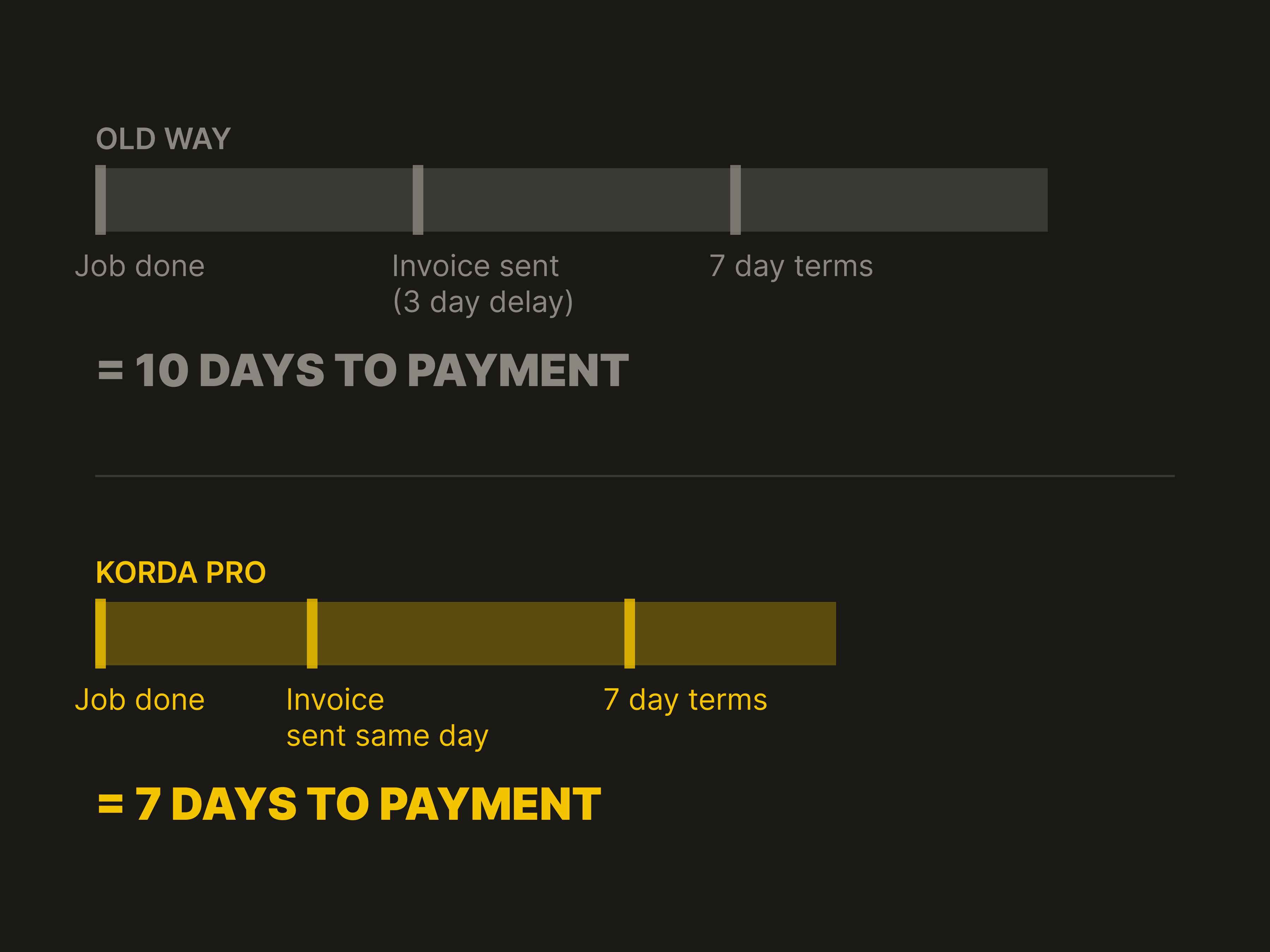
That's sixty days of payment delay per month, sitting invisibly across your receivables. On a seven-day payment term, your effective collection cycle is already ten days before a single client pays late. Stretch the invoicing delay to five days, closer to reality for tradies who batch on Fridays, and the effective cycle is twelve days on a seven-day term.
Then there's the follow-up gap. Most tradies don't consistently chase overdue invoices. Follow-up happens when the pressure gets uncomfortable, usually later than it should. For invoices in the 30- to 60-day bucket, recovery rates drop, not dramatically, but measurably. Some of those invoices get written off. Some get paid eventually, but only after conversations nobody wanted to have.
For a trade business turning over $400,000 to $600,000 a year, a consistently late invoicing cycle (three to five days per job, plus irregular follow-up) works out to roughly one or two lost jobs' worth of revenue. Money earned but never efficiently collected.
The barrier isn't the task, it's the switch
Here's what's useful to understand about why invoicing apps fail at the driveway moment, even good ones.
The invoicing task itself is not particularly hard. Enter a few details, hit send. Five minutes, maybe less if you know the app well. The barrier is not the task. The barrier is the switch, the act of leaving one context and entering another at a moment when your attention is already split.
Every step between where you are and where the invoice gets sent is a place to defer the task. Open a different app: one step. Log in: two steps. Create a new job: three steps. By step three, the mental cost of doing it now versus doing it later has crossed the threshold where 'later' wins.
This is why making the invoicing app faster or simpler doesn't solve the problem. You can reduce the steps inside the app, but you cannot reduce the first step: leaving the app you're already in. The only way to remove that step is to not require it.
Voice-to-invoice isn't unique any more, and that's not really the point
It's worth naming plainly: Korda Pro isn't the only place a voice note can now turn into an invoice. However, our mission is clear: to get you paid faster. Through SMS, WhatsApp, and Email, we will automatically track and chase unaccepted quotes and unpaid invoices.
That doesn't undo the argument above. The friction problem this article describes isn't solved by any tool that drafts an invoice from a message, it's solved by a system that captures the whole job in that same thread: the quote before the work starts, the photos as it happens, a variation if the scope changes, and the invoice at the end, with a follow-up sequence that actually tells you when it's fired. JAX picks up at the last of those steps, once there's already a billable line for it to work from. Everything before that still needs a home.
The driveway moment this piece is built around isn't really about who can generate an invoice from a voice note. It's about whether the whole job, not just the billing step, ever has to leave the conversation it started in.
What changes when the invoice leaves the driveway
The client experience is different when the invoice arrives while the job is still fresh.
A client who receives an invoice an hour after the work is done is still mentally in the job. The quality is recent. The disruption to their day is recent. Their intent to pay, which is almost always genuine regardless of how slow the eventual payment is, is at its highest.
An invoice that arrives three days later lands in a different inbox, on a different day, in a different context. It competes with everything else that accumulated while it was waiting to be sent.
This isn't a marginal difference. Payment psychology research on small business invoicing consistently shows that invoice delivery speed is one of the strongest predictors of payment speed, independent of the payment terms stated on the invoice.
Beyond client psychology, there's the accounting dimension. An invoice sent from the driveway is a Xero record created the same day. Your aged debtors report is accurate. Your GST position is current. The financial picture you see when you check cash flow reflects what actually happened today, not what you got around to entering three days ago.
The client who received the invoice an hour after you left is a different payer to the client who received it three days later.
Systems that fit the behaviour win
The tradies who've made this shift aren't more disciplined than the ones who haven't. They haven't found a deeper motivation or a better Friday afternoon routine. They've changed the system so the invoice goes out when the job is done, because the system now lives in the same app as the job.
Voice note into WhatsApp. Draft comes back. Approve. Done. The ute is still in the driveway.
This is the principle behind every behaviour change that actually sticks: the system has to fit the existing behaviour, not require a new one. You're already on WhatsApp. You're already sending messages from the job site. You're already in the moment when the invoice should go out.
The only thing that had to change was where the invoice came from, and where everything before the invoice lives too. That's what WhatsApp job management is, in practice, for Australian trade businesses: invoicing, quoting, and job tracking built into the app tradies already use on site, rather than a separate app they have to remember to open.
Speed matters before the job, too. The 2-7-14 rule is a simple way to follow up quotes without being pushy.
Frequently asked questions
What is WhatsApp invoicing for tradies?
WhatsApp invoicing lets a tradie send a voice note or message describing a completed job directly in WhatsApp, and have an invoice drafted and sent from that same conversation, without switching to a separate invoicing app. Platforms like Korda Pro connect this workflow to accounting software such as Xero so the invoice is recorded automatically.
Why do tradies delay sending invoices?
Most delays come down to friction rather than a lack of discipline. Sending an invoice through a separate app means leaving the current task, logging in, creating a new job record, and re-entering details from memory. Each step is a point where the task gets deferred, usually to the evening or the following Friday.
Does invoicing faster actually get tradies paid faster?
Invoice delivery speed is one of the strongest predictors of payment speed, independent of stated payment terms. An invoice sent while the client is still mentally engaged with the completed job is more likely to be paid promptly than one that arrives days later, once other priorities have taken over the client's attention.
What is WhatsApp job management?
WhatsApp job management refers to running core trade business admin, quoting, invoicing, payment tracking, and client communication inside WhatsApp rather than a standalone job management app. It's designed around where tradies already work rather than asking them to adopt a new habit.
Isn't this the same as Xero's JAX assistant?
Not quite. JAX can also turn a voice note into a draft invoice, but only once the job is already a billable record in Xero. Korda Pro captures the job earlier than that- the quote, the photos, any variation, as well as the invoice- and follows up automatically once it's sent via SMS, WhatsApp and Email.
How does Korda Pro fit into this?
Korda Pro is a WhatsApp-native invoicing and job management platform built for Australian trade businesses, with direct Xero integration. It's designed so invoicing, quoting, and payment follow-up happen from the same WhatsApp thread a tradie is already using with the client, rather than a separate app.