What Your Xero Aged Debtors Report Is Actually Telling You (and What to Do About It)
The most useful Xero report for tradies is also the least opened. Read your aged debtors report in two minutes a week and chase overdue invoices early.
Korda Team

The aged debtors report is the most useful report in Xero for a trade business. It's also the least opened. Most tradies who have Xero have seen it mentioned by their accountant, in a Xero tutorial, somewhere, and have never actually looked at it.
Here's what it is, where to find it, and exactly what to do with each number.
What It Is
The aged debtors report is a list of every invoice you've sent that hasn't been paid yet, grouped by how long it's been sitting unpaid. It tells you who owes you money and how long they've had it. Nothing more, nothing less, but for a trade business, that's the most valuable information available.
It does not tell you about invoices that have been paid. It does not show your expenses or your bank balance. It is specifically and entirely focused on money owed to you but not yet collected.
How to Find It
In Xero: go to Reports in the top navigation. Select All Reports. Under the Receivables section, find Aged Receivables Summary. Click it. Set the date to today. Run the report.
That's the aged debtors report. Bookmark it. You'll use it every week from this point.
The aged debtors report tells you exactly who owes you money and how long they've had it. It's the most useful report in Xero for a trade business and the least read.
What Each Column Means
The report groups unpaid invoices into time buckets. Here is what each one is telling you.
Current: invoices within their payment terms. The due date hasn't passed yet. No action required, the clock is running normally.
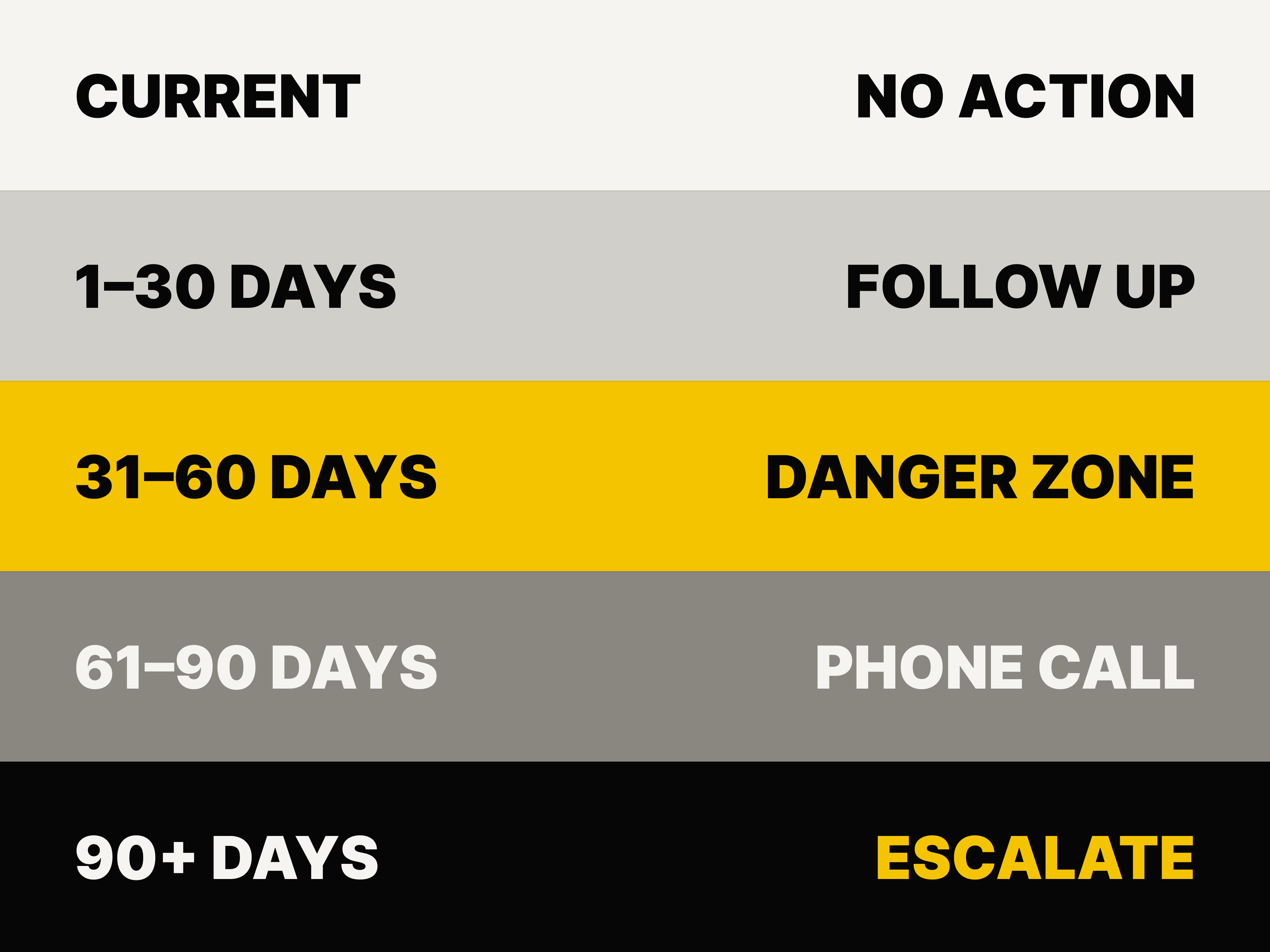
1-30 days overdue: past the due date by up to a month. These clients have missed their payment window. They may have forgotten, they may be slow payers, or there may be a query on the invoice. This bucket is where your follow-up starts.
31-60 days overdue: overdue by one to two months. This is the danger zone. The longer an invoice sits here without action, the harder it becomes to collect. A client who owes you money for 45 days is a different conversation from a client who owes you for 14 days.
61-90 days overdue: two to three months. At this point, collection rates begin to drop noticeably. The client has either decided not to prioritise payment, encountered a genuine problem, or filed the invoice somewhere they won't look. These need a phone call, not a message.
90+ days overdue: more than three months. Recovery becomes materially harder with every passing week. Some of these will be written off. Recoverable accounts need escalation, a formal demand letter, a payment-plan conversation, or a path to dispute resolution.
What to Do for Each Bucket
| Bucket | What to do |
|---|---|
| Current | No action. Monitor. For larger amounts, set an automated reminder to trigger seven days before the due date. |
| 1-30 days overdue | Send a professional follow-up assuming good intent. Most in this bucket have simply forgotten and pay within 48 hours of a prompt. |
| 31-60 days overdue | Follow up requesting a specific payment commitment. If you don't get a response within 48 hours, it's time to call, not email again. |
| 61-90 days overdue | Phone call, not a message. State a reasonable consequence if it stays unresolved, and document the conversation. |
| 90+ days overdue | Formal demand letter if the amount warrants it, or a payment-plan conversation if there's a genuine cash flow problem behind the delay. |
Why Leaving It to Your Accountant Means Acting Too Late
If the only time you see your aged debtors report is when your accountant prepares it, typically quarterly, sometimes monthly, you're looking at information that's already weeks old. An invoice that entered the 31-60-day bucket last month is now in the 61-90-day bucket. The conversation that would have been easy is now harder.
Quarterly financial management is better than none. Weekly is what actually moves the needle on collection.

Making It a Two-Minute Weekly Habit
The aged debtors report takes two minutes to review when you check it weekly. It takes two hours to manage when you leave it for a month.
Same time every week. Monday morning works well; you see what's overdue before the week begins, and you can send follow-ups while the week is fresh. Friday afternoon also works; you close the week with a clear picture of what's outstanding.
Two minutes. One report. The most useful thing you can do for your cash flow this week.

Frequently asked questions
Where do I find the aged debtors report in Xero?
Go to Reports, select All Reports, and under the Receivables section find Aged Receivables Summary. Run it with today's date to see every unpaid invoice grouped by how overdue it is.
How often should I check my aged debtors report?
Weekly. Checking it once a quarter, the typical accountant cadence, means acting on information that's already weeks out of date. A two-minute weekly check catches invoices while follow-up is still easy.
What should I do with an invoice that's 90 days overdue?
Send a formal demand letter if the amount warrants it, or open a payment-plan conversation if there's a genuine cash flow issue behind the delay. If there's no response, the relevant state tribunal (NCAT, VCAT, QCAT, or SAT) is the next step for amounts under $20,000.